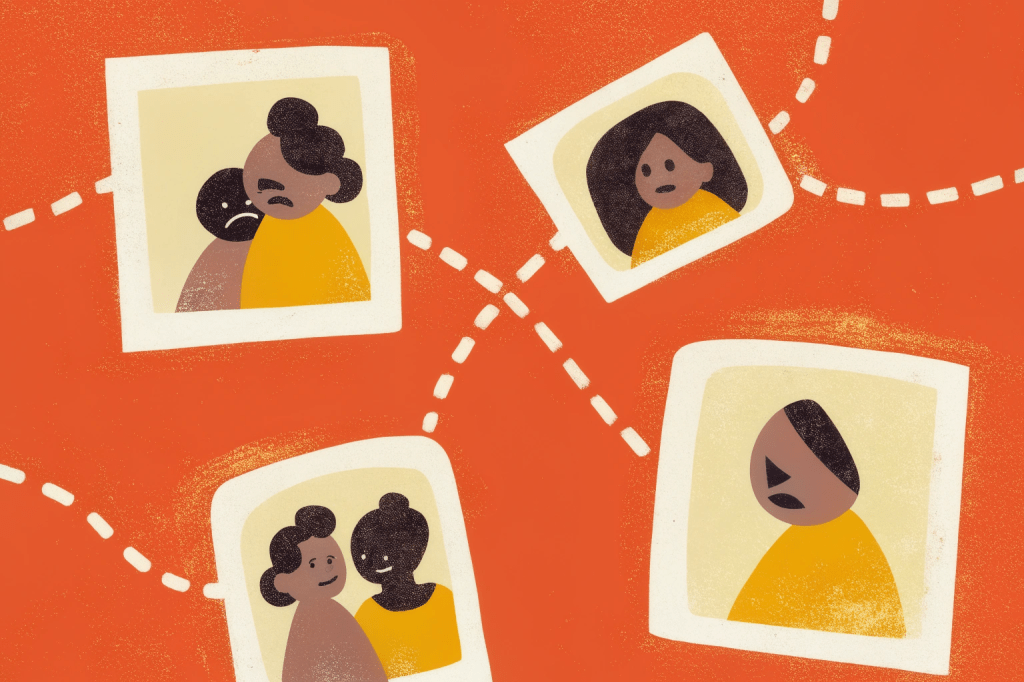
History has a way of repeating itself. As I reflect on my life and the countless lives that preceded it, I see how they have shaped the path leading to where I stand today. I currently live in a house built by my mother and her sister, adjacent to the home where their youngest sibling resides with her family. That house was their childhood home. Despite some updates and improvements, it remains largely unchanged. In contrast, the house I live in has expanded both outward and upward, yet it feels as though it has lost something intangible—a soul, perhaps. Childhood memories seem erased under new paint and linoleum flooring. While I can still glimpse the mountain through the window, the view is now partially obstructed by the extended porch.
Change is inevitable as we grow. People adapt to new circumstances, but deep-seated fears and beliefs often persist across generations. Today, I read an article titled Telling Stories for the Next Generation: Trauma and Nostalgia, which explored how grandmothers in South Africa share family stories with their children and grandchildren. These stories draw from their experiences during apartheid, a period of profound political and personal struggle. These women serve as bridges between the hardships they endured and the lives of younger generations, weaving narratives that intertwine pain with joy. Their storytelling fosters understanding of the past while grounding their families in the present.
The article underscored their pivotal roles within their families as sources of guidance and support. These grandmothers instill values such as respect, discipline, and community, striving to create opportunities for their children and grandchildren to lead better lives. While some painful memories remain untold, the wisdom they impart enables healing and growth.
This made me realize that I don’t need to wait until I become a grandmother to share our family’s stories. Every meaningful story, like those of myth and history, begins with a remarkable figure. In our family, that figure is a woman who left an indelible mark on us all.
As a teenager, my visits home from the city always began at my great-grandmother’s house. Sadly, you never had the chance to meet her. She passed away in 2008, three years before you, my eldest, were born, and seven years before you, my youngest, arrived.
Her house, built in 1902, was a humble wooden structure reminiscent of a longhouse. The roof, constructed of wooden planks, had likely not been replaced since its construction. The porch had a small gate secured by a simple hook—not for safety, but to signal her absence. Her door was rarely locked; visitors, including me, could come and go as they pleased.
The interior was modest. The main room—no more than 300 square feet—functioned as a bedroom, living room, dining room, and kitchen. Two single beds were positioned against opposite walls, separated by a small table. One bed was hers, while the other was reserved for overnight guests. Both were impeccably made, adorned with colorful blankets and embroidered pillows. A wood-burning stove dominated a corner of the room, perpetually lit, with something always boiling atop it—whether for nourishment or household chores.
Nearby stood a large cupboard housing dishes reserved for special occasions, along with cherished keepsakes, candies, and a small stash of cash for her grandchildren. The second room, twice the size of the first, remained mostly unused, unheated in the winters, and served as storage rather than living space. My great-grandmother lived alone but was never truly solitary; her life was a testament to resilience.
Her story is both inspiring and sobering. Married young to a wealthy man she did not love while pregnant by another, her life was complicated from the outset. Remarkably, her husband accepted her situation, a rarity for the time. Together, they had a daughter—my grandmother, your Babusya’s mother.
After World War II, as the Red Army seized control of Western Ukraine, my great-grandfather became a resistance leader, a role that ultimately led to his death. To avoid capture, he took his own life. My great-grandmother, also part of the rebellion, was shot twice, captured, and sent to a Russian labor camp, where she spent a decade. During her imprisonment, her daughters were raised by others.
Following her release, she reconnected with the man who fathered her first child. Though married, he fathered another child with her—a son—before leaving her to raise three children on her own. To secure their futures, she married her daughters to men who owned land. My grandmother married at fifteen, gave birth to your Babusya at sixteen, and continued to have children, some of whom were rumored to be fathered by men in the village. Several pregnancies ended in miscarriage, possibly due to familial genetic issues or alcohol-related complications.
A small cross beneath an apple tree in their backyard marks the graves of the unborn. Those who survived, including Babusya, carried neurological and hearing impairments—legacies of a difficult past.
This is only a fragment of our family’s story. There are countless other tales to tell—stories of hardship, resilience, and love. As I piece together these memories, I find myself overwhelmed by their magnitude. Yet, one lesson stands out: we are shaped by the events and choices of those who came before us. If we fail to examine these layers, we risk perpetuating paths not of our own making.
I am still uncovering the source of my drive to forge my own way. Perhaps that layer remains hidden. What I do know is that breaking generational cycles and healing from inherited trauma has become my mission.
I do all of this for you, my loves. My deepest hope is that you, my daughters, will lead lives that are informed, intentional, and authentically your own. The past does not have to dictate the present. Our mothers and grandmothers did their best with what they had, but their stories need not define ours.
With infinite love,
XO, Mom

 Your Neuroverse
Leave a comment